
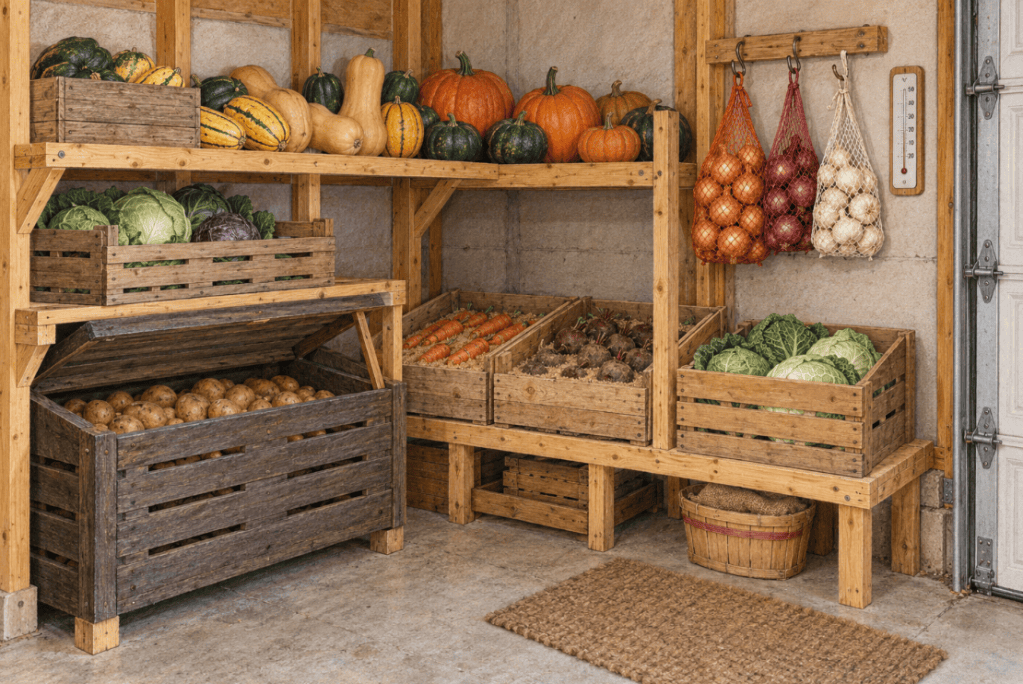
Root Cellaring Without a Root Cellar: How to Eat Local All Winter in Northern Virginia
Ask your grandparents about the root cellar and watch their faces light up. Ask anyone under thirty and you may get a blank stare. That’s a shame, because the root cellar solved a problem we still have today: how do you keep eating good, local food once the harvest goes to sleep for the winter?
Here’s the good news. You don’t need a hole in the ground behind the house to do it. With a little know-how, the potatoes, squash, onions, carrots, and apples you buy from our farmers this fall can keep for weeks and even months. That means local food on your plate in January, long after the last market tent comes down.
And the time to stock up is now. Our Woodbridge location wraps its regular season on Thursday, October 15, and our Stafford location runs through the Last Chance Holiday Market on Sunday, December 20. Fall crops are at their peak, and they’re built to keep.
So what is a root cellar, anyway?
A root cellar is a storage space, usually dug partly or fully underground, used to keep vegetables and fruit fresh through the winter. Before refrigerators, nearly every farmhouse had one.
The idea is simple. A few feet below ground, the earth stays cool and steady all year. A cellar holds a temperature just above freezing, stays dark, and keeps the air moist. Those three things, cool, dark, and humid, slow down rotting, sprouting, and shriveling. A family could put up bushels of potatoes and apples in October and still be eating them in March.
Most of us today live in homes and apartments with no cellar in sight. But the principles still work. You just have to find the right spots in the space you already have.
Not everything belongs in the fridge
This is the biggest surprise for most people. Different crops want different conditions, and the refrigerator is the wrong home for several of them. Think of your storage crops in four groups.
1. Cold and damp: carrots, beets, turnips, parsnips, radishes, cabbage, and apples. These want it as close to freezing as possible without freezing, with lots of humidity. Your refrigerator’s crisper drawer is perfect. Twist off the leafy tops, leaving about half an inch, because greens pull moisture out of the roots. Store roots unwashed in a perforated bag, or bury them in a bin of slightly damp sand the old-fashioned way. Keep apples in their own drawer, since they give off a gas that makes other produce sprout and spoil faster.
2. Cool, dark, and humid: potatoes. Potatoes like it cool but not cold, roughly 45 to 50°F. The fridge is too cold and turns their starch to sugar. Keep them in a paper bag, a cardboard box with holes, or a basket with a cloth over it, somewhere dark. Light turns them green, and green spots should be cut away. Keep potatoes away from apples and onions.
3. Warm and dry: sweet potatoes and winter squash. This group likes it around 50 to 60°F, which is why a cool closet or spare room works well. Never refrigerate sweet potatoes; the cold damages them and leaves a hard core. Leave the stems on squash and pumpkins, and handle them gently, since a bruise is where rot starts.
4. Cool and dry: onions and garlic. These want air moving around them and low humidity. Mesh bags, baskets, or the old trick of knotting them into a leg of clean pantyhose all work. Garlic does fine at cool room temperature but sprouts in the fridge. Note that sweet onions don’t keep long, so use those first and store the sharper storage onions.
The Northern Virginia reality check
Our winters are tricky for storage. We get mild stretches in the 50s, then a cold snap drops us into the teens overnight. A true root cellar evens that out. Your garage does not. So here’s how to make the spaces you already have work.
- Buy a cheap min/max thermometer. For about $10 to $15, it tells you the warmest and coldest your storage spot got since you last checked. It’s the single best tool for this.
- The unheated garage or shed is great for potatoes, squash, and onions through much of the winter. Use an insulated cooler or a styrofoam box as a buffer, and bring everything inside when a hard freeze is in the forecast.
- The basement, if you have one, is the closest thing to a root cellar most of us own. An unfinished corner away from the furnace is ideal.
- No basement or garage? Look for the coolest closet on an outside wall, the floor of a mudroom, or a spare room with the vent closed. That’s your sweet potato and squash spot.
- Check your stash every week or two. Pull anything soft, sprouting, or moldy right away. One bad potato really can spoil the bunch.
Beyond cold storage
Cold storage is the easiest place to start, but it isn’t the only way to stretch the season.
- Freezing. Most vegetables keep their color and texture best if you blanch them first: a quick dip in boiling water, then straight into ice water. Peppers, berries, and herbs chopped into olive oil in ice cube trays can go right in.
- Canning. High-acid foods like jams, fruit, and pickles can be done in a water bath. Low-acid foods like green beans and plain vegetables need a pressure canner to be safe. Always follow tested recipes from trusted sources, such as the National Center for Home Food Preservation or Virginia Cooperative Extension.
- Drying. A dehydrator or a low oven turns apples, herbs, and hot peppers into shelf-stable snacks and seasonings.
- Fermenting. Sauerkraut, kimchi, and fermented pickles are some of the oldest preservation methods around, and all you need is vegetables, salt, and a jar.
And here’s the shortcut: you don’t have to do it all yourself. Many of our participating businesses already do the preserving for you. Jams, jellies, sauces, pickles, local honey, and frozen meats are all local food that keeps. Stocking your pantry with them is one of the easiest ways to Shop Micro all winter long.
Your end-of-season stock-up list
Bring this list to market. Keeping times are approximate and assume good storage conditions; firm, unblemished produce lasts longest.
| Crop | Where to store it | How long it keeps |
|---|---|---|
| Potatoes | Cool, dark spot (45–50°F) | 2–4 months |
| Sweet potatoes | Cool room or closet (55–60°F), never the fridge | 3–6 months |
| Butternut squash and pie pumpkins | Cool, dry room (50–55°F) | 2–3 months |
| Acorn and spaghetti squash | Cool, dry room (50–55°F) | 1–2 months |
| Storage onions | Cool, dry, with airflow | 2–6 months |
| Garlic | Cool room, away from the fridge | 3–6 months |
| Carrots, beets, and turnips | Fridge crisper or damp sand, greens removed | 1–4 months |
| Cabbage | Fridge, loosely wrapped | 1–2 months |
| Apples | Fridge, in their own drawer | 1–3 months, depending on variety |
Ask the farmer which varieties keep best. They know their crops, and they’ll be glad you asked.
Keep local on your plate all winter
Every potato in your basement in January is a dollar that stayed with a local farm family. Root cellaring isn’t old-fashioned. It’s one of the simplest ways to keep Farm to Plate going year-round.
Here’s where to find us for your stock-up trips:
Woodbridge, at Sentara NVMC, 2300 Opitz Blvd.
- Thursdays, 2–6:30 PM, through October 15
- Holiday Markets: Thursday, December 3 and Thursday, December 17, 1–5 PM
Stafford, in the 610 Slug Lot, 163 Staffordboro Blvd.
- Sundays, 8 AM–1 PM (closed November 29)
- Holiday Market: Sunday, December 6
- Last Chance Holiday Market: Sunday, December 20, 8 AM–1 PM
- Winter Markets: February 14 and March 14, 9 AM–1 PM
Come see us, fill your bags, and tell us how your winter stash holds up.
Long Love Local.

